Contracts and collections for candidate-side work
You are invoicing individuals, not corporate AP. That changes the contract, the payment plan, the chargeback risk and what you do the morning month two does not arrive.
July 27, 2026 · 9 min read
Month two does not arrive.
Nobody tells you. There is no bounced-invoice email, no procurement contact to chase, no PO number to reference. A card declines at 3am on the 14th, your processor retries twice over four days, and then the payment is simply not there. Meanwhile your recruiter is still applying for that person forty times a week, because nothing in your delivery process knows that billing stopped.
Two weeks later you notice. By then you have given away a month of capacity for free, and you owe yourself the hardest conversation in this business: asking an individual — possibly one running out of savings — for money.
This is the part of the reverse-recruiting business model nobody sells you on. The candidate-as-payer inversion that makes the category interesting is what makes collections structurally different from every staffing firm you may have worked in before. Get it wrong and it does not show up as a bad debt line — it shows up as a floor of recruiters working on accounts that stopped paying.
Why individual payers break the staffing playbook
In contingent staffing you invoice a company with an AP department, a 30-day convention, a PO that pre-authorised the spend, and an interest in not stiffing its suppliers. When it pays late, it pays late in a predictable, boring way. An individual has none of that. Four differences matter operationally:
There is no separation between the payer and the emotion. The invoice is not a routine business expense to them; it is money they are spending while not earning, during one of the more stressful periods of adult life. That does not make them bad payers, but it does mean your collections tone cannot be a dunning letter.
They pay by card, which means they can dispute. A company cannot reverse a bank transfer because it is unhappy. A cardholder can file a chargeback months later, and you will be arguing about whether the service was delivered as described.
Their incentive to keep paying inverts on success. Traditional clients keep needing you. Yours specifically stop. The moment your client accepts an offer, every remaining instalment feels like paying for something they no longer need — which is exactly when a hybrid or income-share structure asks for its largest payment. Not a reason to avoid success fees; a reason to think hard before selling one. Pricing a reverse-recruiting service works through where each structure puts the collection risk.
Nobody is going to sue for $1,400. Whatever your contract says, your practical remedy for a $500/mo client is stopping work. So the contract's real job is not litigation — it is clarity, consent, and the authority to charge a card on file.
Rule one: signed before a single application goes out
This gets skipped the most because it always feels like a formality standing between you and a keen buyer. It is not. Once you have started working unpaid and unpapered, every subsequent conversation is a negotiation from weakness: you cannot enforce terms they never agreed to, and you cannot stop work without looking like the one who broke faith.
Make it structurally impossible instead. Terms get locked into the document, the document goes out as a link, and the account does not exist in your delivery system until that link comes back signed and month one has cleared. Not a policy. A gate.
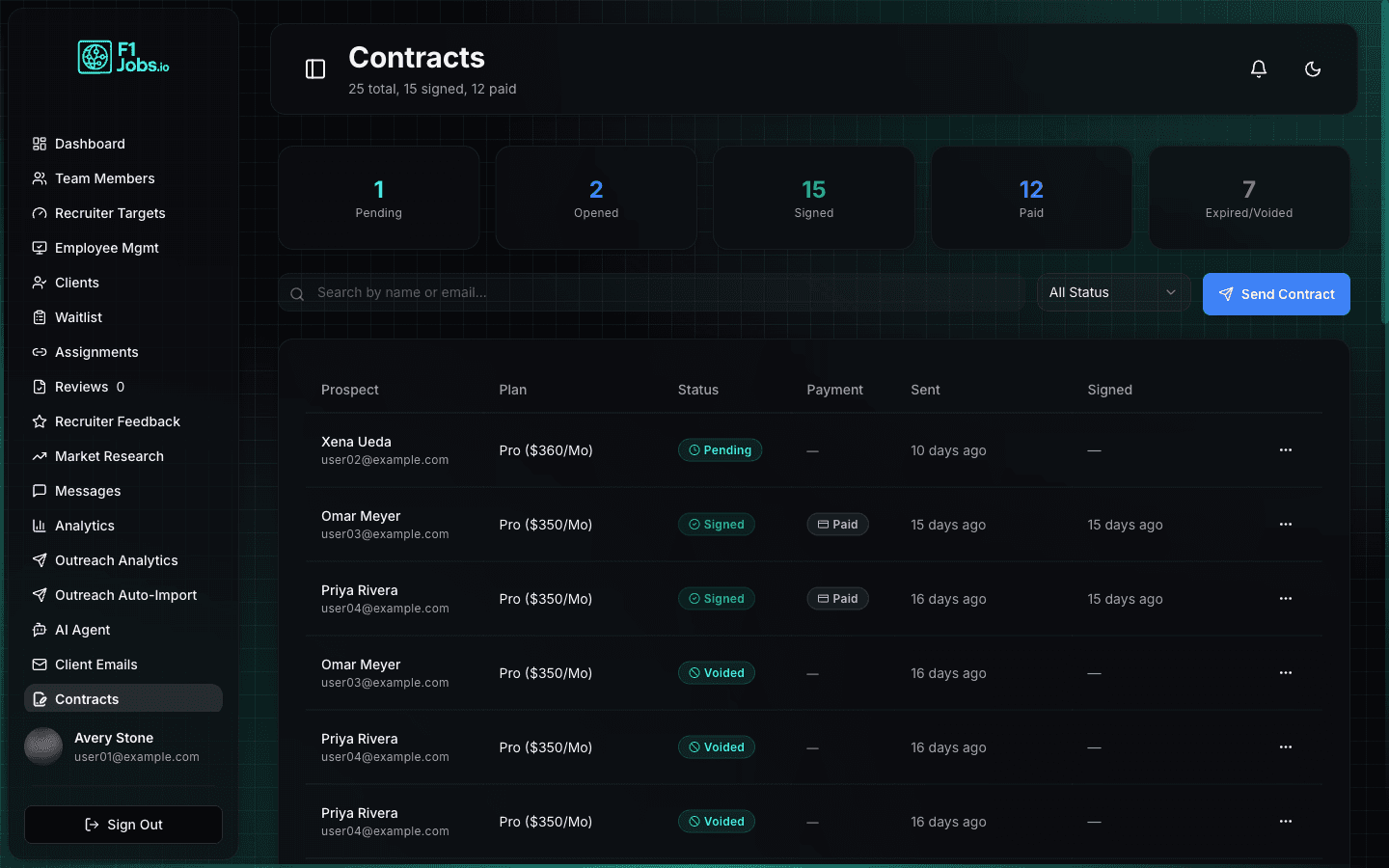
The contracts console in the screenshot above is that gate in practice: 25 contracts sent, 1 pending, 2 opened, 15 signed, 12 paid. Two useful things fall out of a view like that. First, 3 of the 15 signed had not paid — at the $350/mo plan on those rows, about $1,050 of signed-but-unbanked monthly revenue, visible the day it happens rather than at month-end close. Second, 7 of 25 show expired or voided, which sounds alarming until you read the rows: the same prospects appear twice, because a contract was voided and re-sent when terms changed. Your void rate is not your loss rate — but you only know that if the console shows you the sequence.
What actually makes an e-signature hold up
The operator version. In the US, electronic signatures are governed by the federal ESIGN Act and state adoptions of UETA, and the standard framing is that a signature cannot be denied legal effect solely because it is electronic. Four things carry the weight in practice:
- Intent to sign. A deliberate act — drawing or typing a signature — not a pre-ticked box.
- Consent to do business electronically. For consumer transactions ESIGN is stricter: clear disclosures about their rights, affirmative consent to electronic records, and the ability to withdraw consent without penalty. Your client is a consumer. This one is about you.
- Attribution. Evidence tying the signature to that person — the tokenised link sent to their address, timestamp, IP, user agent.
- Retention. A record capable of accurate reproduction later. A PDF hashed at signing (SHA-256), plus an immutable audit log of who opened what and when.
None of that is exotic, and none of it is why firms lose disputes. They lose because nobody can produce the version the client actually signed, or prove the terms in the console today are the terms that were on screen that day. Store the hash, log the events, and that argument disappears.
Separately, and more urgently for some firms: several states regulate paid job-search services directly. California requires employment agencies and employment-counselling services to file a surety bond with the Secretary of State. New Jersey requires career consulting and outplacement organisations to register, bond, and — importantly for your paperwork — give the consumer contract-cancellation rights. New York City requires an employment agency licence to provide job assistance for a fee. Whether you fall inside those definitions depends on how your service is structured and where your clients live. Find out before you paper a hundred of them, with an actual lawyer in your states. This post is not that.
Payment plans: useful, and the largest hole in your cash
Instalments raise conversion. A $3,000 package at three payments of $1,100 closes clients that $3,000 up front does not. It is also, arithmetically, you lending money to someone with no income. Two rules keep that from hurting.
Price the plan. If the instalment total equals the up-front price, you are giving away financing and taking the default risk for free. Charge more for the plan, or discount for paying in full — the discount is not a courtesy, it is you buying certainty, and it is usually the cheapest collections improvement available to a small firm.
Weight the front. Payments collected should always exceed delivery provided. A $4,500 engagement as $2,000 / $1,500 / $1,000 keeps you ahead of your costs. The same $4,500 as $1,000 / $1,500 / $2,000 puts the largest payment due exactly when your client is least motivated — after the interviews start, or after they accept.
And charge a card on file automatically, on a schedule they agreed to in writing. Emailed invoices to individuals are an invitation to think about it.
The morning month two does not arrive
Have a written sequence and run it the same way every time, because the improvised version is always too slow and eventually too harsh.
- Day 0 (decline, not "late"): automated retry, plus a plain, warm message. Cards expire constantly. Most of these are not refusals, and treating them as refusals damages good clients.
- Day 2: a human message from the person they actually talk to — their recruiter, not billing. This is where you learn whether it is a card problem or a money problem, and those get very different responses.
- Day 5: name the consequence without threat. Work continues through a stated date, after which the account pauses. Offer one restructure if they are engaging with you.
- Day 7–10: pause delivery. Not terminate. Pause, in the system, so the recruiter's board no longer shows that book.
That last step is the one firms flinch at, and it is the expensive one. Take a $500/mo client and a recruiter carrying twelve books at $5,000/mo fully loaded: that client consumes about $417/mo of delivery cost. Six weeks of drift — no payment collected, applications still going out — is roughly $750 uncollected plus $625 of capacity spent, about $1,375 gone. On a book where contribution per client runs a couple of hundred dollars a month, one drifting account erases the margin on several paying ones. That is the calculation in the unit economics of a reverse-recruiting desk. The pause is not punitive — it is the difference between a bad month and a bad quarter.
Chargebacks: keep the ratio boring
Subscription services sit at the higher end of dispute rates — commonly quoted around 0.9%–1.2% against an e-commerce average nearer 0.6% — and network tolerance is tightening, with Visa's excessive-dispute thresholds moving down in 2026 and Mastercard's programme escalating on both ratio and count. Cross those lines consistently and the outcome is not a fine, it is losing card processing, which for a firm billing individuals is an extinction event. Three things keep you well clear:
- A billing descriptor they recognise. Your brand — the one on the portal and the contract — not a legal entity name they have never seen. Many disputes are simply people who do not recognise the charge.
- A delivery record you can export. Every application submitted, with a date. When you contest "services not rendered," a timestamped list of 1,600 applications ends the conversation. Firms working out of job-board tabs and a shared inbox cannot produce that, which is why they lose disputes they should win.
- A cancellation path that works. Every friction you add to cancelling converts a churn into a chargeback — which costs you the fee, the revenue, and a tick against your ratio.
Why a signature that provisions the account removes a whole class of admin
Look at what normally happens between "they signed" and "work starts": someone creates a client record, re-types the plan and price, sets up billing, assigns a recruiter, sends credentials, starts the onboarding checklist. Six or seven manual steps, each a place to fat-finger a price, all after the moment your client is most excited and least patient.
Every one of those steps is derivable from the contract. The plan is in it. The price is in it. The schedule is in it. So the sensible design is that signing is provisioning: the signature seals the document, takes month one, creates the account on the plan that was signed, assigns the team, and opens the client's branded portal. Nobody re-types anything, and billing can never disagree with the contract, because they are the same record.
That is what NeuraScribe does with the console at the top of this post — and it is what makes the pause in your dunning sequence one action rather than a scavenger hunt across four tools. The side effect matters as much: the signing page, the descriptor and the portal all carry the firm's own name, which is most of the dispute-prevention list above. See the white-label candidate experience for why that is worth building deliberately rather than accepting a vendor's logo in front of your clients.
The short version
Sign before you work, no exceptions for people you like. Consent, attribution, hash, audit log — that is your enforceability, not the length of the contract. Price instalments and weight them to the front. Run a written dunning sequence with a real pause at the end, because capacity is what you are protecting. Keep the descriptor recognisable and the delivery record exportable. And check whether your states regulate what you sell before you have a hundred agreements to re-paper.
None of this makes collections pleasant. It makes it a process instead of a series of difficult conversations you have too late.