Pricing a reverse recruiting service: retainer, success fee, or hybrid
Success fee, retainer, or hybrid — the model decides how long you survive between placements. The observed price points, and the cash-flow math behind each.
July 27, 2026 · 9 min read
The month you close three success-fee clients is the month your bank balance goes down.
That is not a paradox, it is arithmetic, and it is the most common way a firm with genuinely good delivery ends up funding payroll on a credit card. You signed three people who will each pay 10% of a first-year salary. On a $140k base that is $14,000 a head — $42,000 booked. Booked is doing all the work in that sentence. A white-collar search commonly runs three to six months, longer for senior tech and finance roles; federal unemployment-duration data in early 2026 had the average spell at roughly 25–26 weeks with a median nearer 11–12. Add a notice period and net-30 terms and you are seven to nine months from signature to cleared funds. Your recruiter started applying on their behalf in week one.
Pricing is not a marketing decision. It is the decision that sets how long you can survive between placements, and it deserves to sit alongside the rest of how the reverse-recruiting model actually works rather than being picked off a competitor's site the week you launch.
The three buckets, and what each one really is
Three structures dominate the category. The observed price points are wide, because the segments are wide.
| Model | Observed price points | When cash arrives |
|---|---|---|
| Monthly subscription | ~$150/mo at 50+ applications up to ~$720/mo at 300+; premium retainers $1,000–$3,000/mo | Monthly, in advance |
| Flat-fee package | $1,000–$3,000 entry-level; $8,000–$12,500 executive | Up front, or in installments |
| Hybrid | Retainer plus 9–10% of first-year salary; some configure it as $3,000–$5,500 up front plus 3–4% | A little now, most later |
Those are three different businesses wearing the same job title. The subscription firm is a SaaS business with humans in it. The flat-fee firm is a productized service. The success-fee firm is a venture investor making small, undiversified, unsecured bets on individual job searches. Confusing them is how founders end up with a P&L that looks fine and a bank account that does not.
A pure success fee is a loan you make to your client
Start with cost to serve, because every other number here is a function of it.
Boutique operators typically cap at 20–25 concurrent clients per recruiter, with founder involvement as the differentiator. Take one recruiter at a fully loaded $72,000 a year — $6,000 a month including payroll tax — carrying 22 clients. That is $273 per client per month in recruiter cost alone, before software, before founder time, before the applications themselves.
Run that for the eight months between signature and cleared cash and you have sunk roughly $2,200 of labour into a client who has paid you nothing. Three of them at once is $6,600 out the door before a dollar comes in. That is the mechanism behind the opening sentence, and it has nothing to do with whether your service is good.
Then the contingency. Your fee is not $14,000 — it is $14,000 multiplied by your placement rate, and the clients who never land are pure loss with no recovery event. Worse, the ones who do land will sometimes land through a friend, a recruiter who called them, or an application they submitted themselves in month two. Now you are arguing about causation with someone who has just accepted an offer and has no further need of you. If you cannot show, in a record, which application produced which interview, you will lose that argument more often than you should — which is why attribution on a candidate-side desk is a billing problem before it is a management one.
Income-share agreements at 9–10% of first-year salary amplify every one of these properties and add a new one: you become a consumer-collections operation billing an individual's paycheck over a year. Different regulatory surface, different failure modes, a much longer receivable. Some firms make it work. Almost none of them started there.
A pure retainer is fundable, and capped by your own churn
Flip it. Twenty-five clients at $400 a month is $10,000 MRR. It is predictable, it survives a quarter with no placements, and it is a number you can plan and borrow against. Most firms should start here for exactly that reason.
Two problems, both structural.
The first is the ceiling. Twenty-two clients per recruiter is a real cap, and revenue per recruiter is therefore capped too — at $400/mo that is $8,800 a month of billings per head, at $1,500/mo it is $33,000. To grow you hire, and hiring is where candidate-side firms actually break, because the founder was the product. That is a whole separate failure mode, covered in going from one recruiter to a floor.
The second is that you have priced yourself into a monthly referendum on a process whose natural cycle is longer than your billing period. Month three arrives, the client has had two screens and no offer, and they cancel. Statistically, month three of a search is normal. Commercially, it is the month you got paid for doing nothing they can see.
The fix is not a better invoice, it is a visible one. A client looking at 340 logged applications with dates, job titles and the name of the recruiter who sent each one churns at a materially different rate than a client who gets a Friday summary email. The retainer model lives or dies on whether the work is legible to the person paying for it.
Hybrid is where most firms land, and the reason is honest
The configurations you see in the market are specific. One common shape: $1,500 a month, a guarantee of at least nine interviews inside three months, the first month refunded on placement, and 10% of first-year salary when they land. Another: $3,000–$5,500 up front plus 3–4% of first-year base.
The logic underneath both is the same, and it is the only pricing rule in this post worth memorising:
Set the recurring component to cover fully loaded cost to serve plus a thin margin. Treat every success fee as upside that funds growth, never as the thing that funds payroll.
Run it against the numbers above. Cost to serve is $273 per client per month in recruiter time; add software and a founder allocation and call it $400–$450 all in. A $1,500 retainer clears that with room. A $400 retainer does not — it covers the recruiter and nothing else, which means your entire margin is contingent on placements, which means you are running a success-fee business with a discount attached and calling it a hybrid.
Most firms have never actually calculated cost to serve, which is why so many hybrids are accidentally the second thing. It is worth doing properly before you touch your price list — the unit economics of a reverse-recruiting desk is the arithmetic every one of these models is built on.
What a payment plan actually does to collections
Payment plans are how you sell a $3,000 package to someone who is unemployed. That is a reasonable and often necessary thing to do. It also converts one collection event into three.
The processing cost is a rounding error. On card at 2.9% + 30¢, a $2,100 package charged once costs $61.20; split into three $700 installments it costs $61.80. Sixty cents. ACH Direct Debit at 0.8% capped at $5 turns that same $2,100 into a $5 fee, which across 25 clients a year is about $1,400 you should go and collect — but it is not the argument.
The argument is that installments multiply two things that are not fees. First, decline events: three charges are three chances a card fails, and involuntary churn from a failed card looks exactly like a client who decided to stop paying until someone checks. Second, and worse, motivation decay. Your leverage is highest at signature and lowest at precisely the two moments that matter — the client who has quietly given up, and the client who just accepted an offer.
The second one surprises people. A client who lands in month two of a three-month plan has already got what they came for. Installment three now feels like paying for something that already happened, and every day that invoice sits, that feeling gets more permanent.
Two structural fixes, both unglamorous. Front-load the schedule — 40/30/30 rather than equal thirds — so the balance outstanding shrinks fastest while your leverage is still real. And make the placement trigger the remaining balance rather than the calendar, so the invoice arrives on the day the client is happiest with you instead of thirty days later.
Both of those require the contract, the placement record and the billing schedule to be the same object. If the signed agreement lives in an e-sign tool, the placement lives in your ATS, and the invoice lives in your accounting package, nothing triggers anything and the sequence runs on somebody remembering. That is the practical half of contracts and collections on a candidate-side desk.
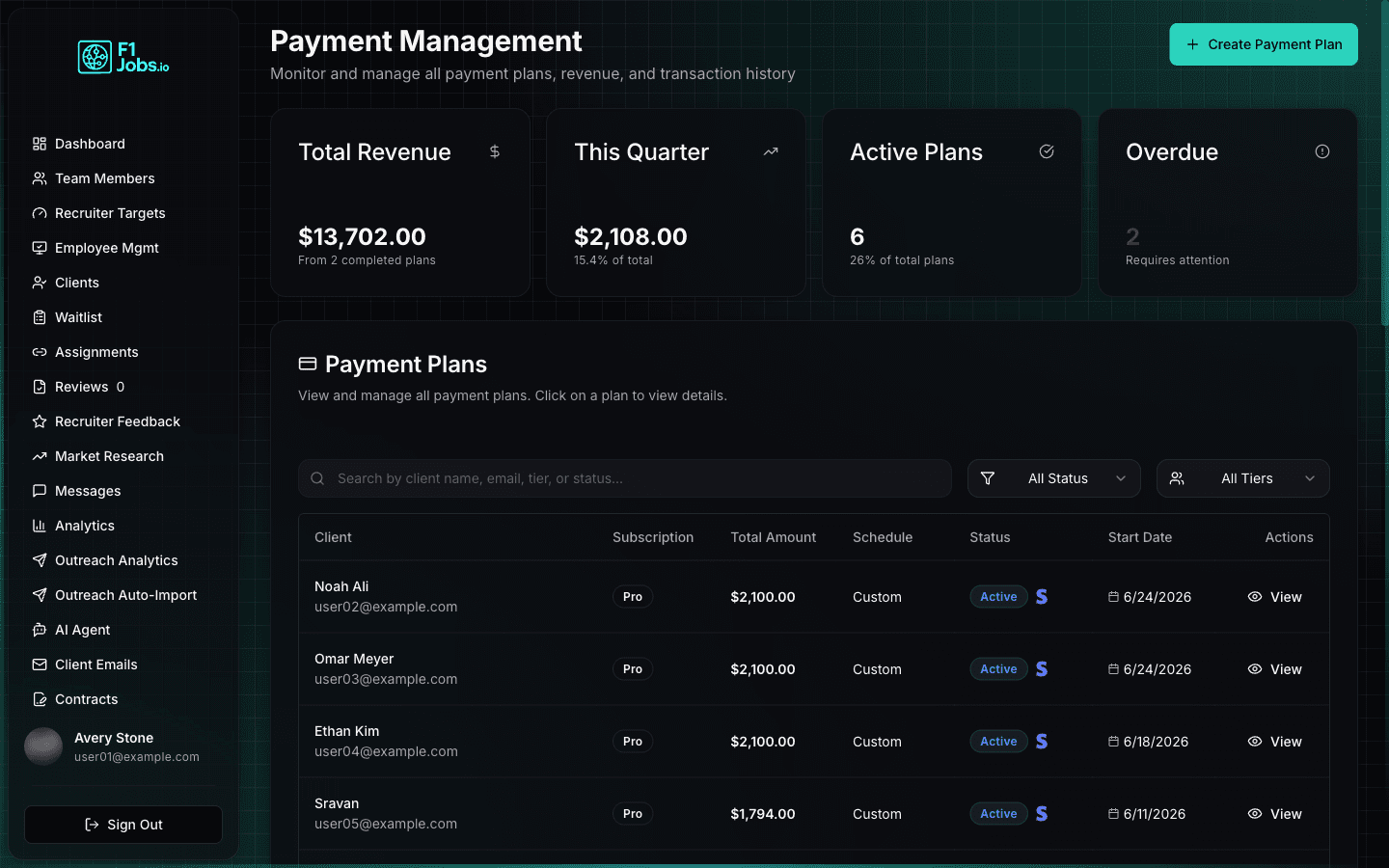
The payments console at the top of this post is that view on a live book: total revenue against completed plans, six active plans, and two flagged overdue. Two overdue out of six live plans is not a crisis — it is a normal Tuesday on a book of installment clients. What makes it normal rather than a nasty surprise is that it is on a screen, in dollars, before anyone thinks to ask. A firm that finds out about those two at month-end has already missed the easy version of both conversations.
Choose the model your balance sheet can afford
Not the one that matches your ambition.
Under six months of runway. Retainer or paid-up-front package. No contingent revenue at all. A success fee is a bet on timing, and you cannot currently afford to be wrong about timing.
Runway, plus a placement rate you can evidence from your own records. Hybrid, with the recurring component set at or above cost to serve. This is where most firms in the category end up, and the reason is cash, not positioning.
Pure success fee. Defensible in exactly one configuration: an executive book where a single 10% fee on a $250k package is $25,000 and you carry six clients rather than twenty-six. Even there, note that the observed executive market mostly prices at $8,000–$12,500 flat — that segment looked at the contingency and largely decided against it.
Whatever you pick, the number to write on the wall is cost to serve per client per month. Every model above is that number plus a decision about who carries the timing risk: you, or the person you are working for. Charge in a way that means the answer is not always you.