Scaling from one recruiter to a floor
What breaks at one recruiter, at five, and at fifteen — plus the first thing to write down and the first person to hire. The second hire is not the one most founders make.
July 27, 2026 · 9 min read
The moment you notice is rarely dramatic. A client emails to ask why she was submitted to a role at the company she left eighteen months ago. You check, and two of your four recruiters applied her to the same posting nine days apart. Neither did anything wrong. Neither had any way of knowing, because the rule about that company lived in your head, and you were on a sales call both times.
That is what the transition from one recruiter to a floor actually feels like. Not a capacity wall — a knowledge wall. The firm keeps working right up until the moment it depends on something only you know, and then it fails quietly, in front of a client, in a way you find out about last. This post is about where those walls sit, what to build before each one, and which hire to make when. It assumes you already know what a desk costs to run; if not, start with the unit economics of a reverse recruiting desk, and for how the whole firm fits together, the operator's guide to the business model.
Stage one: you are the system, and the system is fine
At one recruiter — you — the firm works beautifully and for a reason that will not survive contact with a second person. Every rule is in your head and every decision is yours, so consistency is free. No handoffs, no briefs, no misalignment. This is genuinely efficient, and it is why boutiques that cap at 20 to 25 clients with the founder personally involved can charge a premium and deliver well.
The constraint is not delivery. It is that you are also sales.
A recruiter has roughly 130 productive hours a month. Spend 40 of them selling and you have 90 left to deliver, which at a realistic throughput of about 17 applications an hour is 1,530 applications — around 15 clients at 100 applications a month, not the 22 a pure delivery recruiter could carry. And because engagements in this category commonly run two to three months, those 15 slots turn over roughly four times a year. You need to close 60 clients a year just to stand still, more than one a week, while personally delivering all of them.
So the founder-operator oscillates. Sales month, delivery month, sales month. Revenue arrives in a sawtooth, and every trough is a quarter you were too busy serving to sell. That is a structural property of the one-person firm, not a discipline failure — recognising it is the beginning of getting out.
The first thing to write down is not what you think
The instinct is to document process: the outreach templates, the resume format, the weekly cadence. Useful, but not first. Those are all downstream of one artifact that almost nobody writes:
The client target profile — the written definition of what you will and will not apply to on this person's behalf.
Titles and their acceptable variants. Seniority floor and ceiling. Geography, and whether remote counts. Compensation floor. Industries in and out. Named companies to avoid. Work-authorisation constraints. Which compromises the client has agreed to, and which are hard stops.
Write it once per client at intake, get the client to confirm it in writing, and make it the first thing a recruiter reads before applying. It is boring and it is the highest-leverage document in the firm, for three reasons.
It is the single largest source of rework. Applications the client disputes are a capacity tax, not a quality problem — every redo consumes minutes you already sold to someone else, and it nearly always traces back to a targeting rule that existed only in conversation.
It is the prerequisite for anyone else doing the work. You cannot delegate judgement, but you can delegate a checklist. Until the profile exists, every new recruiter's first month is a series of small errors in front of paying clients.
And it converts a vague promise into a measurable one. "We'll find you a senior product role" cannot be audited. Twelve named titles, three metros, a $160k floor and four excluded employers can be — by you, by the recruiter, and by the client when they claim you went off-brief.
If you do one thing after reading this, it is this. Twenty minutes per client, retrofitted across your existing book this month.
The first hire: delivery, and give them your book
Here is where most founders make the wrong call. Buried in delivery and short on pipeline, they hire a salesperson — and it fails, predictably. The salesperson sells into a firm with no delivery capacity, the founder is still applying to jobs at 9pm, service quality drops on the clients you already had, and you have converted a sales problem into a churn problem.
Hire a delivery recruiter. Then do the part founders skip: hand them your existing book, not the new clients you have not sold yet.
The economics of that sequence are what make it work. A fully loaded recruiter costs around $5,750 a month. Fifteen existing clients at $400 is $6,000 of revenue that already exists, already collected, already delivered — transfer it and the hire is cash-neutral from week one, with no ramp risk and no requirement to sell 22 new clients in a quarter to justify the salary. What you have actually bought is not capacity. It is 130 hours a month of founder time that is now unambiguously sales, funded by revenue you already had.
Compare that with hiring a recruiter to serve future clients: you carry $5,750 a month for a quarter while you sell their book, roughly $17,000 of cash out before contribution, and the founder is still doing both jobs during the ramp.
Two conditions. Do not make this hire before the target profiles are written, or you are paying someone to generate rework. And keep three to five clients yourself, permanently. A founder with no book stops being able to tell whether the work is good, and in a category where clients are individual people paying personally, that is the whole product.
Stage two, three to five recruiters: osmosis stops working
At two or three, everyone still hears everything. Someone asks a question out loud, everyone learns the answer. This feels like culture. It is actually just a small enough room.
Somewhere around the fourth or fifth recruiter, the room gets too big and three things break at once.
Quality goes variable. Your best recruiter and your newest are both delivering "100 applications a month," and those are not the same product. Clients talk to each other. Referrals dry up and you will not know why for a quarter.
Nobody knows who did what. When a client asks why nothing has moved in three weeks, or when you try to work out which recruiter is actually generating interviews rather than volume, the answer lives across four people's memories and a shared inbox. This is the point where attribution stops being a reporting nicety and becomes an operating requirement — enough so that it has its own post on candidate-side attribution.
You become the approval bottleneck. Every edge case still routes to you, but now five people generate them and you answer between sales calls. Response time degrades, so recruiters guess instead of asking. Guessing is where the wrong-company applications come from.
The build at this stage is a review loop, not a management layer. One sampled batch per recruiter per week, read by you against the target profile, with the corrections written back into the profile rather than delivered verbally. Twenty minutes per recruiter per week is 100 minutes at five people — entirely affordable, and it is the last stage at which you can personally hold quality.
Stage three, ten and up: targets, scorecards and a middle layer
Run that review-loop maths forward. At twelve recruiters it is four hours a week of your time, at fifteen it is five, and by then you are not doing it. That is the trigger for your first team lead, and it arrives earlier than published benchmarks suggest.
Corporate talent-acquisition guidance puts a team lead over 10 to 15 recruiters, and staffing agencies often run two to three recruiters per account manager. Candidate-side work sits nearer the tight end, and the reason is arithmetic: each of your recruiters carries around 20 clients who are individual people paying out of their own pocket and who will email on a Sunday. A lead over eight recruiters is already accountable for roughly 160 client relationships. Over fifteen, it is 300, and the lead is a dashboard-watcher who has never spoken to any of them. Put the first team lead in at six to eight, and promote for judgement about targeting, not for personal application volume.
At this size, the informal signals stop arriving. Nobody walks over to tell you a client has gone quiet. You need three things instrumented and visible without asking anyone: a per-recruiter target with actual-versus-target on it, a per-client stall flag that fires on days-since-movement rather than waiting for a complaint, and delivered-versus-promised volume per client so you see the gap before the refund request does. This is precisely what the team-lead tier in NeuraScribe is scoped for — each lead sees only their own team's scorecards and funnel health, with candidates flagged automatically after seven stalled days — because the failure mode at fifteen recruiters is not that people work badly, it is that nobody is looking at the right client on the right day.
Hiring recruiters becomes its own funnel
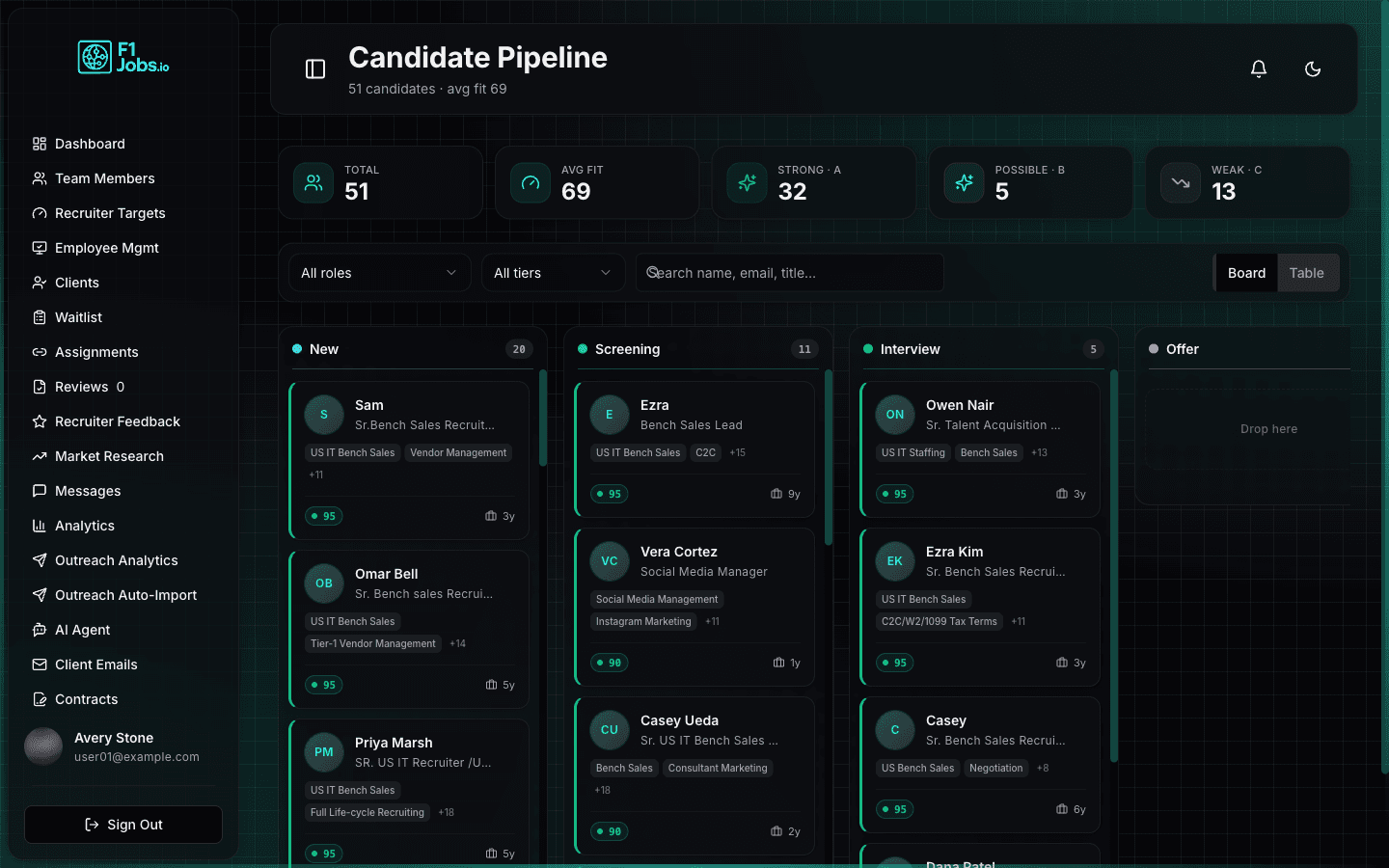
The screenshot above is not a client pipeline. It is a staffing firm hiring its own recruiters: 51 candidates, graded by fit, moving through New, Screening, Interview and Offer. Thirty-two graded strong, eleven in screening, five at interview, none yet at offer.
That is the part nobody plans for. Holding a floor of fifteen requires replacing whoever leaves, and recruiter attrition varies enormously by firm — at 20% you are making three hires a year, at 40% you are making six. Either way, if your funnel converts anything like the one on screen, three hires means screening well over a hundred people. That is a standing process with an owner, not something you do reactively when someone resigns.
Two things make it survivable. Hire against the same fit criteria every time, so you can compare candidates across months rather than against whoever else applied that week. And shorten time-to-productivity, which is a function of the documentation from stage one — with written target profiles and a review loop, a new recruiter delivers safely in two weeks; without them it takes two months and burns client goodwill.
The fork you have to name out loud
One honest complication. If founder involvement is what you sold — and for most boutiques capping at 20 to 25 clients, it explicitly is — then scaling changes the product. You cannot promise personal attention from a founder running a floor of fifteen, and pretending otherwise is how firms earn their first wave of bad reviews.
Two legitimate answers. Systematise so that the founder's judgement lives in the target profiles, the review loop and the quality bar rather than in the founder's calendar, and be straightforward with clients that they are buying the firm's method rather than one person's hours — which also means the experience needs to feel like one firm rather than five individuals, the subject of the white-label candidate experience. Or stay deliberately small, cap at 20 to 25, and raise prices instead. A six-client desk at $1,500 a month throws off as much gross profit as a twenty-two-client desk at $400, with a quarter of the relationships to service, so the boutique route is a real business strategy and not a failure to scale.
What does not work is scaling the headcount while still selling the boutique promise. Pick one, and tell your clients which.