Why your candidates should never see a vendor's name
You have no proprietary supply, so brand is the only asset that compounds. A surface-by-surface audit of every place a vendor's name leaks into the experience your candidate is paying for.
July 27, 2026 · 9 min read
A candidate pays you $2,400 up front. Three days later they get the welcome email, tap through to the portal, and somewhere in the bottom-right corner of the login screen there is a small gray line: Powered by TalentStack.
They will not say anything. They will not churn over it. But something has moved. Ten minutes earlier they believed they had hired a firm. Now they suspect they have bought a login to software, and the price they paid is being silently re-evaluated against what a software subscription costs.
That is the whole argument, and everything below is the operational version of it.
The reason this matters more on a candidate-side desk than anywhere else
Employer-side agencies get away with visible vendor branding because their buyer is a company with a procurement process. No hiring manager has ever canceled a contract because the ATS was obviously Bullhorn. The buyer expects you to run on tools; the tools are not what they are paying for.
Invert the desk and the buyer changes completely. Your buyer is now a person spending their own post-tax money — often $1,000 to $3,000 for an entry-level package, $8,000 to $12,500 at executive level, or a few hundred a month on an ongoing tier — during the most financially anxious period of their adult life. They have been reading Reddit threads asking whether the entire category is a scam. They are looking, actively and slightly paranoid, for evidence about what they actually bought.
And here is the structural problem underneath it, the one that makes this a strategy question rather than a design preference. As the operator's guide to this business model lays out, a candidate-side firm has no proprietary supply. An employer-side agency owns exclusive requisitions and client relationships that genuinely take years to copy. You own none of that. You work public job boards anyone can open, on a resume the candidate already had, using labor they could in principle perform themselves.
What you are actually selling is the belief that your version of that labor is materially better than the alternative. That belief has a name. It is your brand, and it is the only asset in the business that compounds.
The compounding math, since brand arguments usually skip it
Twenty-five clients at $400 a month is $10,000 MRR. Fine business. Now note the thing that makes candidate-side different from almost every other subscription: success ends the subscription. You are contractually obliged to churn your own book.
Say the average engagement runs five months. That is a book that fully turns over roughly 2.4 times a year — you have to originate sixty new clients annually just to stand still. Sixty. At the 20–25 concurrent cap most founder-led shops settle at, your entire year is origination.
There are only three ways to fill that: paid acquisition, which has to be re-bought every month; outbound, which consumes the founder's time; and referral, which costs nothing and arrives pre-trusted. If a third of your sixty come from referral, that is twenty sales a year you did not pay for — call it $8,000 of MRR you did not buy.
Referral has one requirement. The former candidate has to be able to name you, unprompted, six months later, to a friend at a barbecue. Every vendor name in the experience is a competing candidate for that memory slot. If the thing they used every day was called TalentStack, that is what they will say — and their friend will Google TalentStack.
The surface area, in the order candidates hit it
This is the part most firms underestimate. Branding is not the logo. It is a dozen or so surfaces, and the ones that leak are almost always the ones nobody looked at.
The domain. portal.yourfirm.com, not yourfirm.vendor-app.io. The URL bar is the first thing on the screen and the thing that gets pasted into a text message. This is a CNAME and a certificate, so if a platform cannot do it, that tells you what kind of platform it is.
The login page. Logo, color, the name in the browser tab, the favicon, the password-reset copy. Reset emails are the most-forgotten page in software and they arrive at the moment a candidate is already mildly annoyed.
Transactional email — the one almost everyone gets wrong. If your platform sends through SendGrid, Mailgun or Postmark and nobody completed domain authentication on your domain, the provider signs the message with its own domain by default. Gmail then renders via sendgrid.net right next to your sender name, on every single email you send. The fix is a one-time DNS job per firm — SPF, DKIM and DMARC records on your sending subdomain, so the DKIM signing domain aligns with your From address — and any platform serious about white-labeling will hand you the records or create them by API. Check your own sending domain today; the tag is invisible until you look for it, and then you cannot unsee it.
Two related items on the same surface: the reply-to has to be a monitored address at your domain, and the footer must not carry a "sent with" line. Free-tier email plans buy that footer with your brand.
Documents. The prep dossier, the offer comparison, the rewritten resume. Header and footer are obvious. Two that are not: the filename, which lives in the candidate's downloads folder forever and should read Interview_Prep_Splunk_2026-07-15.pdf rather than an export hash, and the PDF metadata. Open any generated PDF, hit Document Properties, and look at Author and Producer. A surprising number of white-labeled documents carry the vendor's name in a field nobody thought to overwrite.
The signing page and the executed contract. This is the highest-stakes surface you own, because it is the exact moment a stranger decides to send you money. The signing link domain, the page itself, and — critically — the ESIGN/UETA audit certificate appended to the executed PDF, which on many e-sign products is a full page of someone else's branding stapled to your agreement. That certificate is also the document you would produce in a dispute, which makes it worth getting right for reasons beyond aesthetics. The same audit trail does real work later, when collections get awkward.
The card statement. Your candidate's bank line item should say your firm's name. If it says the payment platform's name, or the vendor's, you will get support tickets from people who do not recognize the charge, and eventually a chargeback from someone who assumed it was fraud. Statement descriptors are a configuration field. Set them.
Mobile apps. Two separate problems here.
The visible one is the App Store listing: the app name, the icon, and the "Seller" line, which shows the legal entity behind the developer account. A candidate who taps through to that page and sees a company they have never heard of has learned something you did not intend to teach them.
The invisible one is riskier. Apple's Guideline 4.3 targets spam and duplicate apps, and functionally identical apps that differ only in color and logo are exactly what it is aimed at. The pattern developers keep getting burned by is a vendor publishing every client's app under one developer account; the practical answer, and the one Apple's own forums point to, is that each firm needs its own Apple Developer Program account, with the vendor publishing on your behalf. When you evaluate a platform, ask this directly: whose developer account will my app live in? If the answer is "ours, alongside our other clients," your app's continued existence depends on Apple never noticing a pattern.
Notifications and SMS. Push notification titles, the SMS sender ID, the calendar invite organizer name. Small surfaces, high frequency.
In-app support. If your help widget opens a vendor's knowledge base, you have handed off the relationship at the precise moment the candidate is frustrated and looking for someone to blame. Support content should be yours even when the underlying software is not.
The AI. If a prep dossier says it was generated by someone else's AI, you have told your candidate that the most impressive deliverable in your service is a feature of a product rather than a capability of your firm. That is a real subtraction from the value of everything else on the invoice.
Where white-labeling stops and dishonesty starts
An operator should be able to say where the line is, so here it is.
White-labeling is presentation. You built a service, you assembled the components, you are responsible for the outcome, and it carries your name. That is how every serious business works, and no candidate expects you to have written your own e-signature stack.
Concealment of material facts is different, and three things sit on the wrong side of the line. Do not hide that AI is involved in producing work the candidate will be judged on — say it plainly and sell the human review that follows it. Do not obscure who is actually doing the work when the candidate is buying access to a specific person; the "founder-led" pitch stops being true the moment the founder is not on the account, and buyers find out. And do not white-label compliance disclosures, refund terms or the identity of the entity taking the payment. Your brand goes on the surface. It does not go over the disclosures.
The audit, which takes about twenty minutes
Buy your own service. Burner email, personal phone, a card that is not the company card.
Walk the entire flow: marketing site to signing page to payment to welcome email to portal to password reset to first document to mobile app to a support ticket. Screenshot every step. Then go through the screenshots and write down every proper noun that is not your firm's name.
The list will be longer than you expect, and most of it will be email headers, PDF metadata and the App Store seller line — the surfaces nobody demos. Then price the fix. Some of it is DNS records and an afternoon. Some of it is a platform limitation you cannot engineer around, which is a procurement decision and belongs in the same conversation as what the stack actually costs you.
One opinion while you are pricing it: if a vendor charges you extra to remove their logo, they are charging you to run their advertising. Treat that line item as what it is — a marketing expense you are paying on someone else's behalf — and negotiate accordingly.
What "fully white-label" looks like when it is real
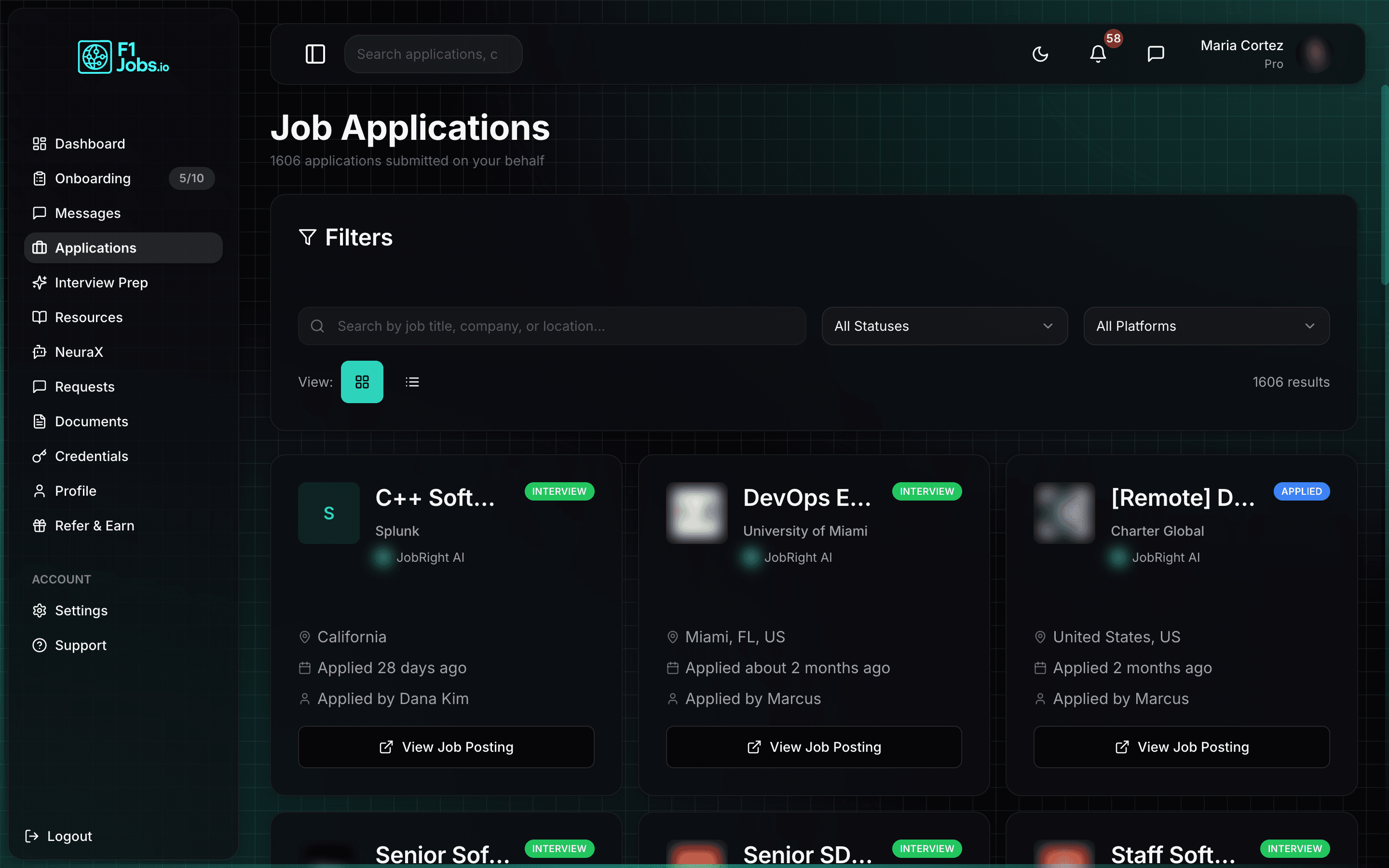
The screenshot at the top of this post is a candidate portal from a live US reverse-recruiting operation: 1,606 applications, each card carrying the company, the status, the source platform and the recruiter who submitted it — the kind of visible attribution that also disciplines your own floor.
The relevant detail is what is not in it. The platform underneath is NeuraScribe. Nothing on that screen says so, and nothing on the login page, the signing link, the emails, the PDFs or the iOS app says so either. The firm's candidates have no idea we exist, which is the correct outcome and the reason we can use their screenshots as proof.
Brand is the only thing in a candidate-side business that survives the book turning over three times a year. Do not lease space on it to your suppliers.