What the reverse recruiting tool stack actually costs you
An ATS, a CRM, e-sign, invoicing, sequencing and chat comes to about $1,329 a month at six recruiters. The person you hire to reconcile them costs four times that.
July 27, 2026 · 9 min read
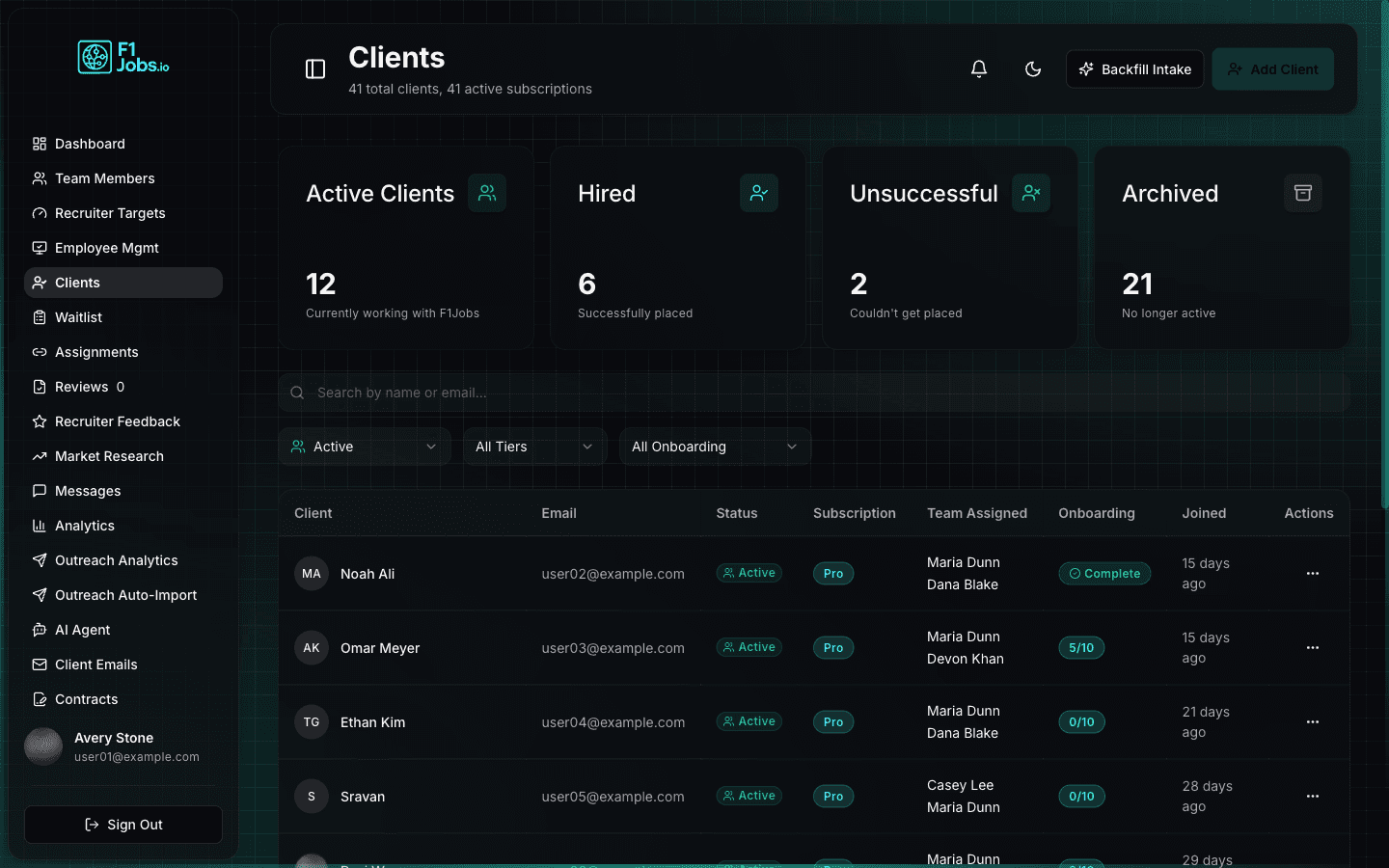
Someone asks a question that should take ten seconds. How many of our active clients still haven't finished onboarding?
Forty minutes later you have an answer you half trust. The client list is in the ATS. The subscription tier is in Stripe. The onboarding checklist is in a shared sheet two people maintain and a third edits without telling anyone. Who is assigned to whom was decided in a Slack thread in March. Nobody lied to you and no tool failed. The information simply does not exist in one place, so a person had to go and make it.
That forty minutes is the actual product of your tool stack, and it does not appear on any of the invoices. Before arguing about consolidation — which is a real argument with a real counter-argument — it is worth pricing both halves honestly. This is the tooling layer underneath the reverse-recruiting operating model, and most firms have never added it up.
Price the software honestly first
Take a firm with six recruiters and two people on sales and admin. Eight heads. Here is what a mid-range 2026 configuration actually lists at.
| Line | Configuration | Monthly |
|---|---|---|
| Applicant tracking | Recruiterflow, $99/user/mo annual × 6 | $594 |
| Sales CRM | HubSpot Sales Hub Pro, 2 seats at $90 + 4 core seats at $45 | $360 |
| E-signature | DocuSign Business Pro, $40/user/mo annual × 2 senders | $80 |
| Invoicing & books | QuickBooks Online Plus | $140 |
| Email sequencing | Instantly Hypergrowth (Smartlead Pro is $94) | $97 |
| Team chat | Slack Pro, $7.25/user/mo annual × 8 | $58 |
| Spreadsheets | Already inside the Workspace bill | $0 |
| Total | $1,329 |
Call it $16,000 a year, plus HubSpot's $1,500 one-time onboarding fee, which is the sort of line that only shows up in the contract.
Three honest caveats before anyone quotes that number at a board meeting.
You can cut it hard. Manatal lists at $15/user/mo on annual Professional, which takes the ATS line from $594 to $90 and the total under $850. You can also inflate it just as fast: Loxo Basic starts at $169/user/mo, putting the same six seats at $1,014 and the stack over $1,700 before anything else changes.
The bill moves under you. QuickBooks Online Plus goes to $140/mo on 1 August 2026, roughly 40% above where it sat at the start of the year. You did not negotiate that and you will not be the last vendor to do it to you. A stack of seven vendors is seven independent opportunities for someone else to reprice your cost base.
Per-seat is not the only meter. DocuSign Business Pro includes 100 envelopes per user per year. Two senders is 200 envelopes. A firm signing 40 agreements a year with the odd amendment never notices. A firm signing 200 agreements plus addenda and payment-plan revisions ends up buying seats it does not need in order to buy envelopes it does — and then discovers the overage at exactly the wrong moment in a quarter.
So: somewhere between $850 and $1,700 a month for a six-recruiter desk, depending on how expensive your ATS taste is. That is the number most owners have in their head when they say "the tools."
Now price the part nobody counts
There are three more costs. None of them arrive as an invoice, and together they are five to six times the software.
The reconciler
At some point around the eighth or ninth active client, a firm hires someone to "help with ops." US operations coordinator pay sits around a $54,400 median, with the middle of the range roughly $41,000–$58,000. Load it with payroll tax and benefits at 1.25× and you are at about $68,000 a year — $5,650 a month, more than four times the entire software bill.
Nobody writes that job description honestly, but here it is: move data between systems that should have been one system, and be the only person who knows where things actually stand. It is a real job, done by capable people, and the whole of it is a tax on the seams. When it goes well you stop noticing the seams — which is worse, because now the cost is permanent and invisible at once.
The reconciliation tax on people you did not hire to reconcile
Twenty minutes a day, per recruiter. Logging an application into a sheet because the ATS field does not match how you actually report. Updating a status in two places. Pasting a contract link into chat so the account owner knows it went out. Six recruiters at twenty minutes is two hours a day, about 43 hours a month.
At a fully loaded $34.60 an hour, that is roughly $1,500 a month — already more than the software line on its own. But the money is the less interesting number.
Forty-three hours is a quarter of one recruiter-month. If your recruiters cap at 20–25 concurrent clients, a quarter of a recruiter is about five clients of carrying capacity that you are paying for and not selling. At a $1,500/mo retainer, five clients is $7,500 of monthly revenue that does not exist.
Be careful with that figure, because it is only real if you would actually sell into the recovered capacity. Plenty of candidate-side firms are demand-constrained, not capacity-constrained, and for them the honest number is the $1,500, full stop. Work out which one you are before you quote yourself the bigger number — that distinction is the spine of the unit economics of a reverse-recruiting desk, and getting it backwards is how firms justify expensive changes that do not move revenue.
Decision latency
The last one has no invoice and no timesheet, and it is the one that costs the most.
Ask which clients have had no interview activity in fourteen days. In a consolidated system that is a filter and takes a second. Across six tools it is a person, a morning, and a spreadsheet that is stale by lunch. So the question stops being asked daily and starts being asked monthly — and by the time you have the answer, the at-risk client has been at risk for three weeks and has already drafted the email.
Attribution has exactly the same shape. If applications live in the ATS and interviews get mentioned in chat, nobody can answer which recruiter's outreach produced this interview without reconstructing it from memory. Firms run without that answer for years and pay for it twice: in comp disputes at review time, and in quietly promoting the recruiter who describes their week most persuasively. That is a fixable data problem, and recruiter attribution on a candidate-side agency is worth solving before it becomes a personnel problem.
The client can see the seams
One cost that shows up in none of the arithmetic: what the stack feels like from the other side.
The agreement arrives from an e-sign domain. The invoice arrives from an accounting package with a different sender name. Status updates come from a recruiter's personal email signature. There is no portal, or there is one and it is a shared folder. Each handoff is a small reminder that the client bought a person rather than a firm — which is fine right up until they compare you to an operator whose whole experience is one thing with one name on it. That comparison is the substance of the white-label candidate experience, and it is decided by your stack long before it is decided by your marketing.
The honest total, and when not to act on it
Software at $1,329. The reconciler at $5,650 once you have hired one. The reconciliation tax at roughly $1,500. Call it $8,500 a month, of which the software is about 16%.
That is a genuine argument for consolidation. It is not an argument for consolidating this quarter.
Migration is expensive in the currency you have least of. Moving a live book between systems costs weeks of attention — exporting, mapping fields nobody documented, discovering that the spreadsheet was the real source of truth all along and the ATS was decoration. You do all of it while still running the desk. Firms that switch mid-quarter with a full book routinely lose more in that quarter than the stack costs in a year, then conclude that consolidation does not work, when what did not work was the timing.
Do not switch when:
- Your stack is three tools and one of them is a spreadsheet you open twice a week. At that size the integration tax is genuinely small.
- You are inside a hiring push or a seasonal peak. Never both at once.
- The pain is one bad tool. Replace the tool. That is a $600 decision, not a platform decision.
Do switch when at least two of these are true:
- You have hired, or are about to hire, someone whose main job is reconciling systems.
- A basic operational question — which clients are stalled, what did this recruiter produce last month — takes more than a day.
- Your billing record and your delivery record disagree, and you are finding out about it from clients.
- Candidates can see the seams.
The clients console at the top of this post is what the consolidated version of that Thursday question looks like: 41 clients, 12 currently active, and every row carrying the subscription tier, the recruiters assigned and how far through onboarding each one is. That is the ATS row, the CRM record, the billing status and the shared sheet occupying one line instead of four systems. It is not a prettier spreadsheet — it is the absence of the reconciliation step. f1jobs.io, the US reverse-recruiting operation NeuraScribe was built out of, runs its entire book that way, which is the only reason we are willing to be this specific about what the alternative costs.
None of which means your stack is wrong today. It means the number you have been quoting yourself — "about $1,300 a month for tools" — is off by roughly a factor of six, and every decision you have made on top of it, including the decision to leave things alone, was made with the wrong number. Price the seams before you renew anything.