Who earned that interview? Attribution on a candidate-side desk
On an employer-side desk one recruiter owns one req and credit is obvious. On a candidate-side desk four people touch one client. Here is what has to be logged at the moment it happens.
July 27, 2026 · 9 min read
A candidate on your book lands an interview at Splunk. It goes in the channel with a fire emoji and everyone is briefly happy.
Now answer the harder question: who earned it?
The application went out 28 days ago, submitted by whoever was on the applying rotation that week. The resume it carried was rewritten a month before that by the strategist who owns the candidate's positioning. The candidate nearly canceled in week two and stayed because someone talked them through it on a Thursday call. Someone else sent the follow-up. Someone is about to write the prep dossier.
Four people. One interview. One row in your system.
If you run a candidate-side desk, this is structural, not occasional, and it compounds with every recruiter you hire. It is one of the quiet reasons the reverse-recruiting model is harder to operate than it looks from the outside, even though the sales motion is simpler.
Employer-side attribution is easy because the requisition is the atom
On a traditional agency desk the unit of work is a job order: a client, an owner, a fee, a start date. When a placement happens the fee attaches to the req, and the req has a name on it. Even the messy cases are solved — finder/filler splits, 50/50 on a cross-desk assist, an account-manager percentage off the top. Those work because there are two or three clearly separable seats and one obvious object to divide.
Invert the desk and the atom disappears.
On a candidate-side desk the object you sell is a person, not a role. Revenue attaches to the candidate — a $400/mo subscription, a $2,500 package, a 10% income-share on the first year — and it arrives on a billing schedule that has nothing to do with which of the 1,606 applications on that candidate's account produced the interview. There is no req to own. There is a book of humans, and everybody on the floor touches everybody's book.
That is why comp plans ported straight from employer-side agencies fall apart by month three. They assume an ownership structure the work does not have.
What a fuzzy record actually costs
Start with the money, because it is the smaller of the two costs and people still get it wrong.
Twenty-five clients at $400/mo is $10,000 MRR, or $120,000 a year — a plausible boutique at the ceiling most founder-led shops cap themselves at. If variable compensation runs a quarter of revenue, you are moving $2,500 a month between people on the strength of your activity record. If a fifth of that lands on the wrong person, you have misallocated $500 a month, $6,000 a year. Annoying, not fatal.
The behavioral cost is the expensive one, and it does not show up in a P&L.
Unattributed work teaches your team what actually gets rewarded, and what gets rewarded is visibility. The person on the Thursday call with the client is visible. The person who sent 180 applications on Tuesday between 9pm and midnight is not. Run that for two quarters and your appliers quietly reduce volume, because volume is invisible and therefore free to withhold. Your coaches start scheduling more calls than the work requires, because calls are the thing people can see.
You will not notice this as a morale problem. You will notice it as a throughput problem — application volume drifting down 10% a month with no explanation — and you will go looking for a tooling fix for something you caused with a comp plan.
The second-order version is worse. The category already has a trust problem with buyers, and the recurring complaint in public reviews is that the experience varies enormously depending on which person inside the firm gets assigned to the account. That is what an attribution vacuum produces: if nobody can see who did what, nobody manages who did what, and quality becomes a function of individual conscientiousness. That is not a service. It is a lottery with a monthly fee — and it is why what you charge is only half the retention question.
Reconstruction is the failure mode, not bad intentions
Nobody on your floor is lying in the Monday meeting. They are remembering, which is worse, because memory is confident.
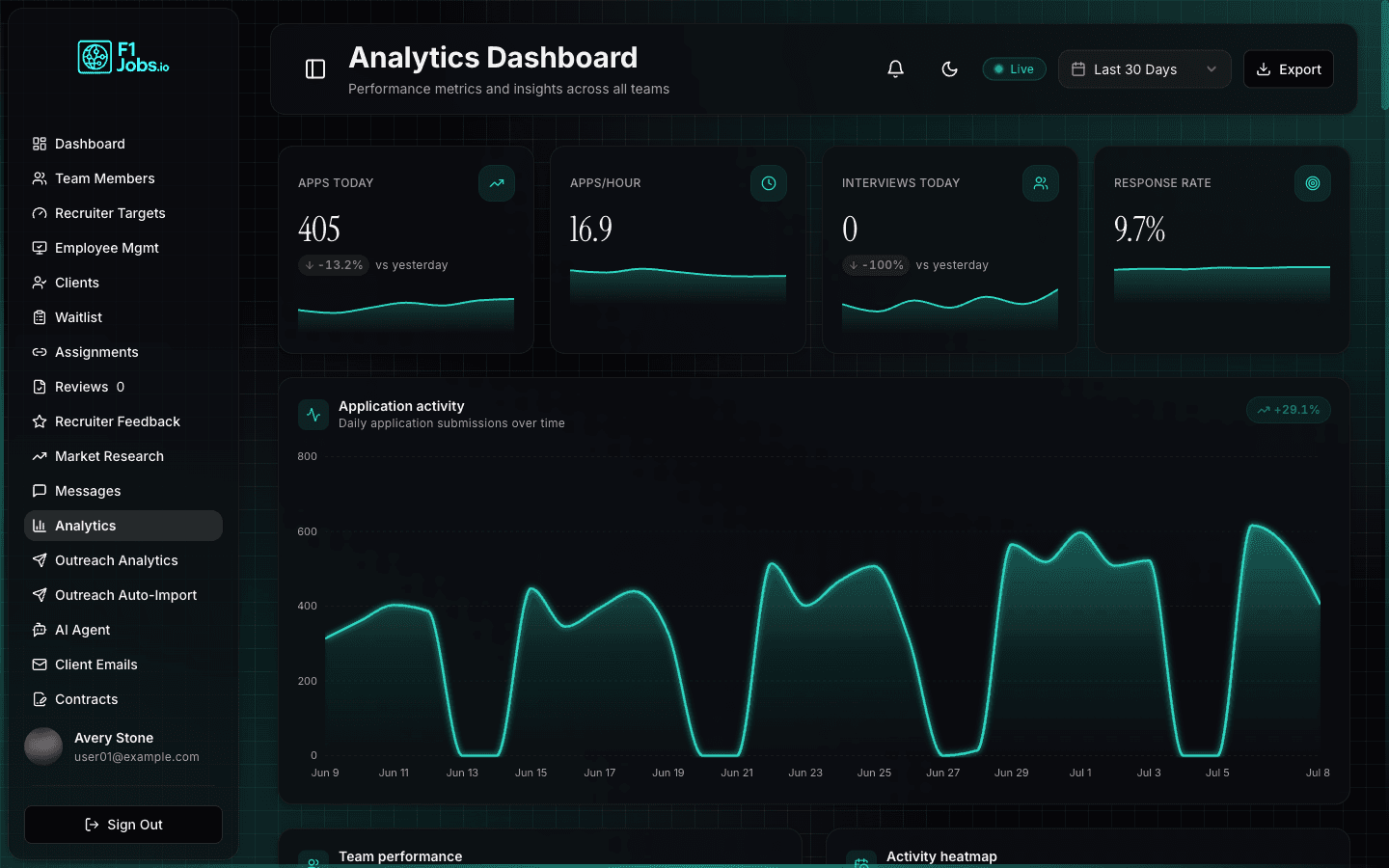
Look at the volume you are asking people to remember. Twenty-five clients on a 300-applications-a-month tier is 7,500 applications a month leaving your firm. The dashboard at the top of this post is from a live US reverse-recruiting operation: 405 applications logged that day, 16.9 an hour, a 9.7% response rate over the prior thirty days. Run 7,500 applications at roughly that response rate and you are generating on the order of 700 inbound events a month — replies, screening requests, scheduling emails, rejections, recruiter InMails.
Seven hundred events. Reconstructed on a Monday, from memory, by people who were busy.
What you get is recency bias plus confidence bias. The interview that landed Friday is vivid; the application that caused it, sent four weeks earlier by someone who has since sent nine hundred more, is not. So credit goes to whoever was standing closest to the outcome, which on a candidate-side desk is almost always the relationship owner rather than the person who did the work that produced it.
Log it at the moment of the action, or don't bother
There is no software fix for a record built after the fact. The only fix is that the record is a by-product of doing the work, not a separate task that happens later.
Six things need an actor and a timestamp stamped on them at the instant they occur:
The application. Candidate, company, role, job board, timestamp, and who submitted it. Not "the team." A name.
The outreach. Every email sent on the candidate's behalf, with the sender and the thread. Outreach is where the biggest skill gap between recruiters lives and the least-logged thing in most firms.
The document. Which resume version that application carried, and who wrote it. If a rewrite moved response rate from 6% to 11%, that is the most valuable fact in your business — and you can only see it if documents are versioned and attributed.
The status change. Applied to screening to interview, with who moved it and on what evidence. Most firms skip this one. It matters most, because it is the moment credit gets created.
The client touch. Calls, chat, the save in week two. Relationship work is real work; the problem is that it is currently the only work being counted.
The prep. Who produced the dossier, and when it landed relative to the interview.
One rule governs all six: the actor is stamped by the system, never typed by the human. The moment a recruiter has to select their own name from a dropdown, your log is biased toward whoever is most conscientious about paperwork, which is not the same population as whoever is best at the job. Attribution that depends on self-reporting is just a slower Monday meeting.
The join problem nobody warns you about
Here is the part that breaks even well-instrumented firms.
Applications go out through your system. Interviews arrive somewhere else — a recruiter emails the candidate directly, or texts them, or the candidate mentions it on a call three days later. The signal that creates the credit does not arrive on the same rail as the work that earned it.
So attribution on a candidate-side desk is fundamentally a join: match an inbound event to one of hundreds of outbound actions. You can only do that join if the outbound record carries enough to match on — company, role title, board, and date. Then a reply from Splunk on July 8th matches the Splunk application submitted June 10th, and the credit resolves without anyone remembering anything.
Two consequences follow. The candidate portal has to be where status changes happen, because the candidate learns about the interview first; if they mention it on a call three days later, the record is already secondhand. And every application needs its source platform captured, because when a candidate says "a recruiter reached out," you need to know whether that was your application or genuine inbound. Paying commission on inbound the candidate generated themselves is a fast way to lose the room.
Three attribution models, and the one I would pick
Last-touch to the applier. Whoever submitted the application that produced the interview gets the credit. Clean, defensible, no arguments. It also pays for volume and pays nothing for the resume rewrite that made the volume convert, so over time your response rate erodes while your application count looks great. Fine for a two-person shop. Dangerous once you have specialists.
Weighted split. A fixed model — say 60% applier, 25% strategist, 15% account manager — applied to every attributed interview or placement. Honest about the fact that the work is collaborative. The weights are a policy choice, not a discovery; do not pretend you derived them from data, just publish them and defend them.
Book-level pool. Pay on the candidate's outcome and split by role weights fixed in advance across everyone who touched that book. This is the right answer for most boutiques capped at 20–25 concurrent clients, where the same three or four people touch every candidate anyway and per-interview splitting is administrative theater.
Pick one, write it down, publish it before the quarter starts. The only genuinely bad option is deciding in arrears, because a comp plan invented after the results are known is not a comp plan — it is a negotiation, and the best negotiator wins. Ask anyone who has watched a plan get "clarified" the week commissions were due.
Whichever you choose, keep the attribution record independent of the comp plan. You will change the plan; you should not lose the history when you do. That separation is the same discipline that makes the unit economics of a desk legible in the first place.
Two numbers that only exist if attribution does
Interviews per 100 applications, by recruiter. The most useful management number on a candidate-side desk, and uncomputable without per-application attribution. It separates the recruiter who sends 400 mediocre applications from the one who sends 200 targeted ones and books more interviews. Without it you manage on volume, and volume is what you get.
Time from onboarding to first interview, by cohort. Your churn number in disguise. Candidates who go five weeks without an interview cancel, ask for refunds, and leave reviews.
Both of these become recruiter targets you can actually defend in a one-to-one, which is the thing that lets you put a second and third recruiter on the floor without the quality collapsing.
Make attribution client-facing, not an internal secret
The best-run candidate-side desks do something slightly counterintuitive with all of this: they show it to the client.
In the platform this site runs on, every application in a candidate's portal carries the line Applied by Dana Kim under the company and the date. The candidate paying $400 a month can see, on any of their 1,606 applications, which human submitted it and when. That line does two jobs. It is the proof of work that justifies the invoice — the hardest thing to demonstrate in a service whose output is effort. And it is self-policing: an attribution record the client can read is one nobody on your floor can quietly rewrite on a Monday.
The same rows roll up into the owner view at the top of this page. Applications today, applications per hour, response rate, interviews, team performance — none of those tiles are separate reporting. They are the same records, counted.
The test
Ask yourself one question, and be honest about the answer.
If your best recruiter resigned tomorrow, could you prove from the record which interviews they earned — not the ones they were near, the ones they earned?
If answering that requires a meeting, you do not have attribution. You have folklore, and you are paying commission on it.