Reverse recruiting: an operator's guide to the business model
What reverse recruiting is as a business, not as a service: who pays, when, and the five things — pricing, capacity, attribution, collection, brand — that decide whether the firm makes money.
July 27, 2026 · 9 min read
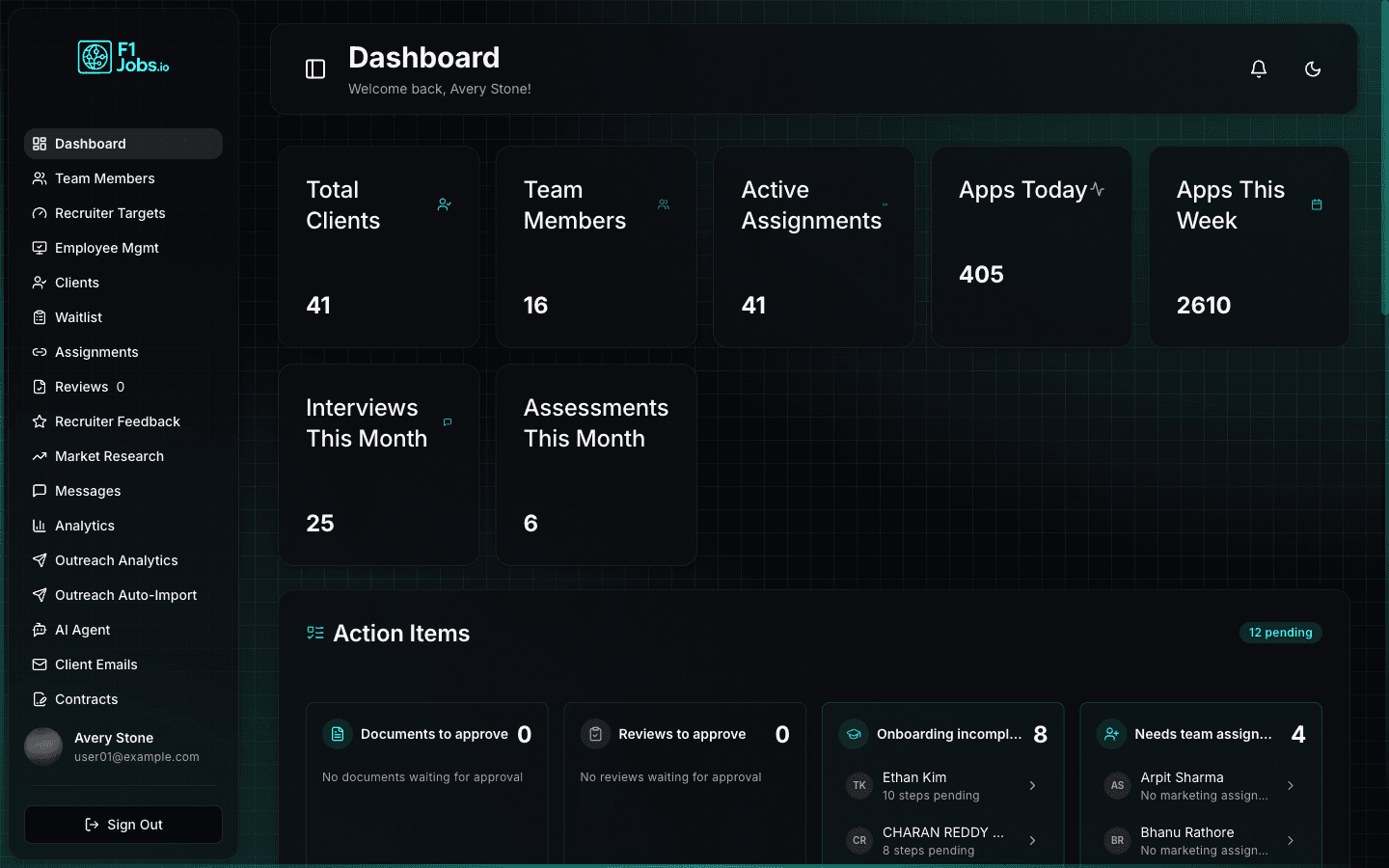
The month a reverse-recruiting firm gets into trouble is usually its best sales month.
You close six clients in four weeks. Every one of them was sold on volume — "we'll run your search for you" — and every one of them starts the clock on the day they pay. Week one you are fine. Week three you are personally logging into job boards at 11pm because the one recruiter you have is carrying eighteen books instead of ten, the applications are getting sloppier, and the client who signed first is emailing to ask why nothing has happened yet.
Nothing is broken. The business is just doing exactly what you designed it to do, and you designed it while you were selling.
This is the piece I would send to someone who says they are thinking of starting one of these. Not what reverse recruiting is — you already know, or you would not be reading an operator's blog about it. What it is as a business: where the money comes from, where it leaks, and the five decisions that separate a firm with 40 clients and a floor of recruiters from a founder with a spreadsheet and a bad month coming.
The inversion, and what it does to your P&L
In traditional staffing the employer pays. That single fact organises everything else: you invoice a company, you invoice on placement or on a margin per hour, and the entity that owes you money has an accounts-payable department, a purchase order, and a reputation to protect.
Reverse recruiting flips the payer. The candidate is the client. You source the roles, tailor the applications, submit them, chase the follow-ups, and prep the person for the interviews you generate. The recruiter works for the job seeker, not for the hiring company.
Three commercial consequences follow immediately, and most new operators only price for the first one.
Your revenue arrives before the outcome does. Traditional contingent staffing gets paid on placement. Most reverse-recruiting money is collected up front or monthly, which is a far better cash position — you are not financing six months of work on hope. The trade is that you now owe delivery to people who have already paid, which is a much less forgiving obligation than owing effort to a client who has not.
Your buyer is an individual. They have no AP department, no net-30 convention, and a genuinely different emotional relationship to the invoice. They pay by card. They can dispute the charge. They can stop paying in month two because they got an offer, or because they did not. Collections is a different discipline here and it deserves its own treatment — see contracts and collections for candidate-side work.
Your delivery cost is roughly linear. In a placement business a great month costs you almost nothing extra. In this business every new client consumes recruiter hours from day one, forever, until they leave. Revenue scales with clients. So does cost. That is the whole game.
The five things that decide whether you make money
1. The pricing model decides your cash flow before it decides your margin
Three buckets dominate the market: monthly subscription, flat-fee package, and hybrid — a retainer plus a percentage of first-year salary.
The observed range is wide. Entry-level packages run roughly $1,000–$3,000. Monthly tiers start near $150/mo for something like 50+ applications and climb to around $720/mo at 300+ applications, with premium and executive-focused services quoted anywhere from about $1,499/mo up to $4,500/mo, and executive packages in the $8,000–$12,500 band. Income-share agreements sit around 9–10% of first-year salary, sometimes structured as a smaller retainer plus 3–4%.
Those are not five variations of the same business. They are five different businesses.
A $150/mo subscription at 50 applications is a volume operation. It only survives if a recruiter can carry thirty or forty of them, which means the work has to be nearly all systematised. A $10,000 executive package is a consulting business with maybe five or six live engagements per operator and the founder's name on the delivery. An income-share agreement is a lending business wearing a recruiting costume: you fund months of delivery against a contingent payment you may have to chase from someone who no longer needs you.
Pick deliberately. The full argument — including why pure ISA is usually wrong for a firm under about twenty-five clients — is in pricing a reverse-recruiting service.
2. Capacity per recruiter is the actual product
Here is the arithmetic almost nobody does before launch.
Take the $720/mo, 300-applications tier. Three hundred applications a month is about fourteen per business day, per client. If a recruiter can genuinely produce sixty considered applications a day — tailored, logged, followed up — that is four clients. Four clients at $720 is $2,880 a month of revenue against one fully-loaded US recruiter. That does not work. It is not close to working.
So one of three things has to be true: the price is higher than the volume tier implies, the applications-per-day number is much higher than sixty, or the labour is not US-based. Every reverse-recruiting firm that survives has quietly chosen one. Most choose the second, and the way you get there is not heroics — it is removing the twelve seconds of copy-paste and logging that sits behind every single application.
For scale: the dashboard at the top of this post is a live US operation. Forty-one active clients, sixteen people, 2,610 applications logged in a week. That is about 64 applications per client per week, and roughly 163 per head per week across everyone on the platform, recruiters and non-recruiters alike. Twenty-five interviews booked that month across the whole book. Run that ratio yourself before you promise anyone an interview in week two — and expect it to move a lot with seniority and vertical.
The cost side matters as much as the volume side, and it is where the quiet money goes: an applicant tracker, a CRM, e-signature, billing, campaign email, an AI vendor, and eventually a person whose whole job is gluing them together. What a reverse-recruiting tool stack actually costs puts numbers on that. Then run the full desk model in the unit economics of a reverse-recruiting desk.
3. Attribution is the thing you cannot bolt on later
Boutique operators commonly cap at 20–25 concurrent clients and sell the founder's involvement as the differentiator. That is a real and defensible business. It also has a ceiling, and the ceiling is you.
The moment you go past one recruiter, you need to know which recruiter produced which interview. Not roughly. Specifically — recruiter, platform, time-from-application-to-interview. Without it you cannot pay commission fairly, you cannot tell a coaching problem from a market problem, and you cannot answer the only question that matters when a client churns: was this book badly worked, or badly sold?
Firms that skip this end up managing on volume, because volume is the only thing they can see. Volume is a terrible management metric — it rewards the recruiter who fires off two hundred untargeted applications and punishes the one who spent the morning on eight that landed. Recruiter attribution in a candidate-side agency covers how to instrument it, and why retrofitting attribution onto eighteen months of history is a job nobody ever finishes.
4. Cash collection is an operations problem, not a finance problem
Twenty-five clients at $400/mo is $10k MRR. That is the number people put in the deck. The number that decides whether you make payroll is how much of it actually lands.
Two things break it. The first is signing after work starts — "we'll paper it next week" — which converts a client into a favour. The second is treating a missed instalment as an accounting event to reconcile at month end rather than an operational event to act on that day. A client who stops paying in month two but stays on the delivery board costs you twice: the revenue you did not collect and the recruiter hours you spent anyway.
5. Brand is the retention mechanism, not the marketing
Candidates do not churn because the work is bad. They churn because they cannot see it. A person who has paid $500 and heard nothing for eleven days assumes nothing happened, and they are not being unreasonable — from where they sit, nothing did.
The fix is boring and it works: show them the applications as they land, under your name, on your domain. It is also the thing that lets you charge more than the volume shops, because a client who can watch the work does not experience the price the same way. The white-label candidate experience makes the case, including why a candidate who sees a third-party vendor's logo in their portal is a candidate quietly learning they could go direct.
The composite number
If you want one metric for this business, it is contribution per client per month: what a client pays, minus the fully-loaded recruiter time and tooling cost of serving them.
Say $500/mo, a recruiter carrying twelve books at $5,000/mo fully loaded, and $40/client/mo in tooling. Delivery cost is $417 + $40 = $457. Contribution is $43. That firm is one refund away from a loss and cannot afford a single stalled collection.
Move the same recruiter to eighteen books and delivery drops to $278 + $40 = $318. Contribution goes to $182 — a 4x improvement from one change, and no price increase. That is why capacity work beats pricing work in the early years, and why every hour spent removing manual logging pays back faster than an hour spent on the website.
Then, and only then, the shape of the firm changes: you stop being a very busy recruiter with clients and start being an owner with a floor. Going from one recruiter to a floor is about what breaks at that transition — because what breaks is never the recruiting.
What I would actually tell a friend
Pick one pricing model and one client profile and hold both for a year. Sign everyone before you work for them. Instrument attribution on day one even though you have one recruiter, because you will have four. Measure applications per recruiter per day like it is your gross margin, because it is. Put your own brand on everything the candidate touches.
And run one honest calculation before you sell the next retainer: at your price, on your book, how many clients can one recruiter carry before quality drops? Whatever that number is, it is your business model. Everything on this page is a footnote to it.
NeuraScribe is the operating system behind that dashboard — one data model from signed contract to attributed interview to paid invoice, under the firm's own brand. It exists because f1jobs.io, a US reverse-recruiting operation, needed exactly the arithmetic above to stop living in eight tools and a spreadsheet.